
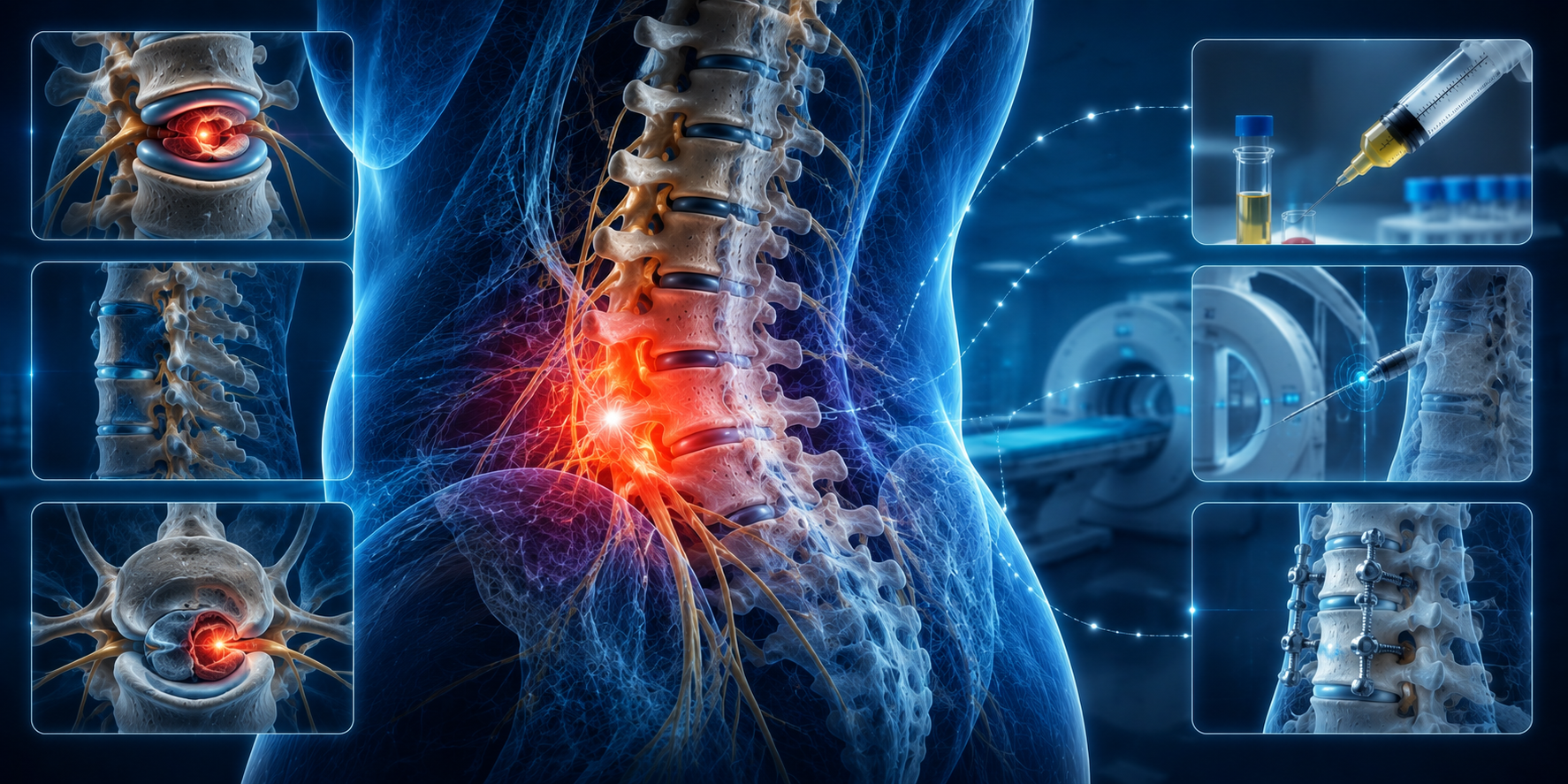
Being told you may need spinal surgery is a difficult moment for any patient. For many people dealing with herniated discs, spinal stenosis, facet joint degeneration, or chronic back and neck pain, surgery can feel like the inevitable next step. But for a significant number of patients, surgery may not be the only path forward.
At ATL Regen, we work with patients across Atlanta, Smyrna, Macon, Riverdale, LaGrange, Stonecrest, and Huntsville who are looking for a clear second opinion before committing to an operation. Our focus is on interventional spine care and regenerative medicine — approaches that address the source of spinal pain without requiring general anesthesia, hospitalization, or a lengthy surgical recovery.
This article explains what non-surgical spinal care looks like, which conditions it applies to, and when surgery is genuinely the more appropriate path.
Why patients explore alternatives before surgery
Spinal surgery is not a small decision. Even for procedures considered minimally invasive, there are real risks involved: infection, anesthesia complications, nerve injury, adjacent segment disease, and failed back surgery syndrome — a condition where pain persists or worsens after an operation.
Many patients also deal with long recovery timelines. Returning to full function after spinal fusion, for example, can take months. For people who are working, caring for family, or managing other health conditions, that timeline matters.
Beyond the practical concerns, some patients are simply not convinced their diagnosis requires surgery. They want to understand whether the imaging findings they have been shown — a disc herniation, stenosis, or degenerative changes — are truly the cause of their symptoms, or whether non-surgical treatment could provide meaningful relief.
These are legitimate questions, and they deserve a thoughtful answer.
Spinal conditions that often respond to non-surgical care
Not every spinal condition requires surgery. The following are among the most common diagnoses where interventional and regenerative approaches may offer real benefit.
Lumbar disc herniation
A herniated disc occurs when the soft inner material of a spinal disc pushes through its outer casing and compresses a nearby nerve. This can cause back pain, leg pain, numbness, or weakness — a pattern often called radiculopathy or sciatica.
Many disc herniations improve over time with appropriate conservative and interventional care. Image-guided epidural steroid injections, nerve blocks, and targeted regenerative treatment can reduce inflammation and support recovery without surgery.
Spinal stenosis
Spinal stenosis refers to narrowing of the spinal canal, which can put pressure on the spinal cord or nerve roots. It often causes pain, cramping, or weakness in the legs, particularly with walking or standing.
Depending on the severity and location of the stenosis, interventional pain procedures can provide meaningful relief. These approaches do not reverse the anatomical narrowing, but they can reduce the nerve irritation and inflammatory response that drives much of the pain.
Facet joint arthritis and pain
The facet joints connect the vertebrae and are a common source of chronic back and neck pain. When these joints degenerate or become inflamed, they can generate significant discomfort and limit range of motion.
Facet joint injections, medial branch blocks, and radiofrequency ablation are well-established interventional techniques for diagnosing and managing facet-mediated pain. For some patients, platelet-rich plasma (PRP) injections into the facet joints may also be considered.
Degenerative disc disease
Disc degeneration is a natural part of aging but can become a significant pain source when discs lose height, flexibility, and shock absorption. Patients often experience chronic axial back pain, stiffness, and reduced function.
Regenerative approaches such as PRP may support disc health and reduce the inflammatory environment around degenerated discs. Combined with targeted interventional care, many patients see improvement in pain and daily function.
Cervical disc and facet conditions
Neck pain related to disc disease or cervical facet arthritis can cause headaches, stiffness, and radiating pain or numbness into the arms. These conditions often respond to cervical interventional procedures, including epidural injections and facet blocks, before any surgical option becomes necessary.
What non-surgical spinal care at ATL Regen looks like
At ATL Regen, our approach to spinal conditions begins with a careful evaluation — not a predetermined treatment plan. The goal is to understand what is actually causing the pain before recommending any intervention.
Thorough clinical evaluation
Every patient starts with a review of symptoms, medical history, prior imaging, and previous treatments. This context matters. A disc herniation on an MRI does not automatically explain someone's pain. Understanding the pattern, duration, and character of the symptoms is essential for making a sound recommendation.
Image-guided injections
When an injection is appropriate, precision matters. Our procedures are image-guided, which means the treatment is delivered exactly where it is intended to go. Fluoroscopic or ultrasound guidance helps ensure accuracy — a critical factor in both diagnosis and outcomes.
Common interventional procedures include:
- Epidural steroid injections for disc-related nerve pain and radiculopathy
- Selective nerve root blocks to identify and treat specific nerve compression
- Facet joint injections for arthritis-related back and neck pain
- Medial branch blocks as both a diagnostic and treatment tool
- Radiofrequency ablation for longer-duration facet pain relief
- Trigger point injections for myofascial components of spine-related pain
Platelet-rich plasma (PRP) for spinal conditions
PRP is derived from a small sample of a patient's own blood. After processing, the concentrated plasma — rich in growth factors — is injected into the target structure. In the spine, PRP may be used for disc conditions, facet joints, and certain soft tissue injuries.
PRP is not appropriate for every patient or every condition, and it is not a substitute for accurate diagnosis. But for selected patients who have not responded adequately to standard care, it may offer a meaningful next step before considering surgical options.
Outcome tracking and protocol refinement
ATL Regen tracks outcomes across our patient population. This data informs how we approach treatment decisions and refine protocols over time. Patients can ask directly about how similar cases have responded — we believe that transparency supports better decisions.
When surgery is the right answer
Non-surgical care is not appropriate for every patient. There are situations where surgery is the correct and necessary path.
If a patient has significant neurological deficits — progressive weakness, loss of bladder or bowel control, or rapidly worsening function — surgical intervention may need to happen without delay. Conditions such as cauda equina syndrome, severe cord compression, or spinal instability from fracture or tumor require surgical evaluation.
Surgery may also be appropriate when a patient has exhausted appropriate conservative and interventional care over an adequate period, when the structural problem is severe enough that injections are unlikely to provide durable relief, or when imaging findings correlate closely with symptoms in a way that makes surgical correction the most direct solution.
The goal at ATL Regen is not to avoid surgery at all costs. It is to make sure that patients who do pursue surgery are doing so because it is genuinely the best option for their specific condition — not because no one offered them a thorough non-surgical evaluation first.
What to expect when you come to ATL Regen
When you schedule a consultation at ATL Regen for a spinal condition, the first appointment focuses on understanding your situation in full. We review your imaging, discuss your symptoms, and perform a focused examination.
From there, we give you a clear explanation of what we see as the likely pain generator, what treatment options we think are appropriate, and what outcomes look like for patients with similar presentations. If we believe your condition is better served by surgical referral, we will tell you that directly.
Patients are not pushed toward injections or regenerative treatment simply because that is what we offer. The recommendation should fit the clinical picture.
Multiple locations across Georgia and Alabama
ATL Regen serves patients across a wide regional footprint, making it easier to access a thorough spinal evaluation without traveling to a major academic medical center. Our locations include:
- Smyrna
- Stonecrest
- Riverdale
- Macon
- LaGrange
- Huntsville, Alabama
If you are dealing with back or neck pain and have been told surgery may be your next step, a consultation at ATL Regen can help you understand whether a non-surgical path is realistic for your condition.
Schedule a consultation to speak with our team about interventional spine care and regenerative medicine options for your situation.
