
Knee pain is one of the most common reasons patients seek non-surgical care. It can come from many different sources — cartilage breakdown, ligament stress, tendon irritation, bursitis, or referred pain from the hip or lumbar spine. That variety is part of why knee pain can be so frustrating to treat. A recommendation that works well for one patient may not fit another, even when the complaints sound the same.
At ATL Regen, we evaluate knee pain carefully before recommending any treatment. Platelet-rich plasma, or PRP, has become a well-discussed option for knee-related conditions, and for the right patient it can be a meaningful part of a non-surgical recovery plan. But PRP is not a generic fix for all knee pain, and it should never be the starting point before the diagnosis is clear.
Why knee pain is so common
The knee is one of the most mechanically demanding joints in the body. It absorbs impact during walking, running, stair climbing, and standing. It depends on multiple structures working together — cartilage, menisci, ligaments, tendons, and surrounding muscle — and when any of those structures are stressed, injured, or worn down, the result is often pain that interferes with daily movement.
Patients often describe:
- pain that worsens going up or down stairs
- stiffness after sitting for long periods
- swelling that comes and goes
- a sense of instability or giving way
- aching at rest that disrupts sleep
- difficulty squatting, kneeling, or crouching
These symptoms can overlap across several different diagnoses. That is why a careful evaluation matters before treatment begins.
Common causes of knee pain
Understanding what is generating the pain is the most important step in deciding whether PRP makes sense.
Osteoarthritis
Knee osteoarthritis involves the gradual breakdown of articular cartilage — the smooth tissue that allows the joint to move without friction. As cartilage wears away, bone surfaces can come closer together, and the joint becomes inflamed and painful. Osteoarthritis is one of the most studied conditions for PRP use in the knee.
Meniscus pathology
The menisci are two C-shaped pads of fibrocartilage that sit between the femur and tibia. They help distribute load and stabilize the joint. Tears or degenerative changes in the meniscus can cause pain, swelling, catching, or limited range of motion.
Patellar tendinopathy
Also called jumper's knee, this condition involves irritation or degeneration of the patellar tendon, which connects the kneecap to the shinbone. It is especially common in people who run, jump, or perform repetitive squatting movements.
Iliotibial band syndrome
The IT band is a thick band of connective tissue running from the hip to the outside of the knee. When it becomes tight or inflamed, it can cause lateral knee pain that worsens with activity.
Post-traumatic knee pain
Knee pain after an injury — from an auto accident, a fall, a sports collision, or a workplace event — can involve any of the above structures, sometimes in combination. These cases require careful imaging correlation to identify what was actually injured.
What PRP does in the knee
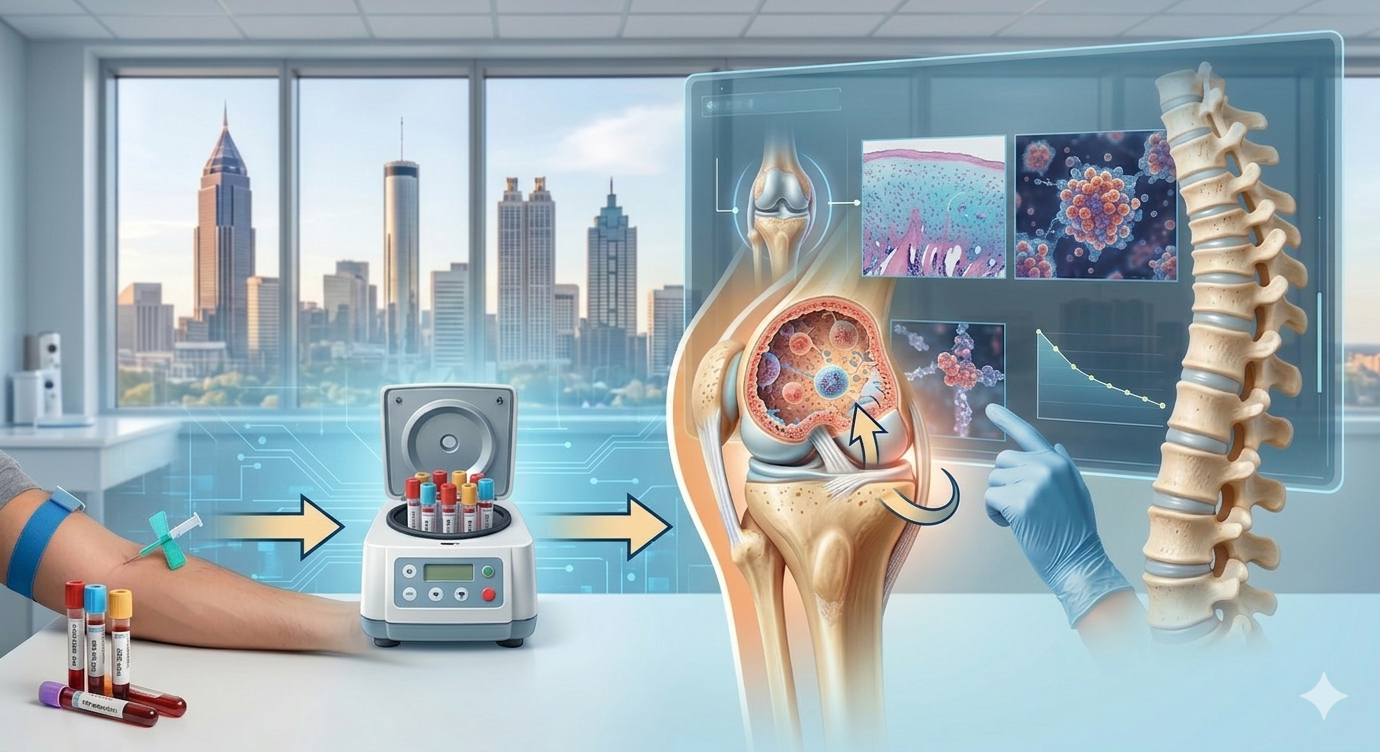
PRP is prepared by drawing a small sample of the patient's blood, processing it to concentrate the platelets, and injecting the resulting solution into the target structure. Platelets contain growth factors and signaling proteins that are involved in tissue repair and inflammation modulation.
In the knee, PRP may be used to:
- reduce the inflammatory environment in osteoarthritic joints
- support healing in tendon or soft tissue pathology
- address chronic pain in structures that have not responded to rest and conservative care
PRP is not a structural repair. It does not rebuild lost cartilage or re-attach torn ligaments. What it may do is support the body's own healing processes in tissue that is chronically irritated, inflamed, or showing early degenerative change.
Who may be a good candidate for knee PRP
PRP is most appropriate when there is a clearly identified pain generator that matches the injection target, when conservative care — rest, activity modification, physical therapy, anti-inflammatory treatment — has been tried and has not provided adequate relief, when the degree of structural damage is not so severe that it would require surgical correction, and when the patient's overall health and goals are compatible with a biologic treatment approach.
Early to moderate knee osteoarthritis, patellar tendinopathy, and certain soft tissue conditions are among the presentations where PRP may offer meaningful benefit. Advanced arthritis with bone-on-bone changes, significant mechanical instability, or a full-thickness meniscal tear that is causing mechanical symptoms may not respond adequately to PRP alone.
What the research suggests
PRP for knee osteoarthritis has been studied more than almost any other musculoskeletal application. The body of evidence is growing, though it is still evolving. In general, studies comparing PRP to placebo or to corticosteroid injections have found that PRP may offer more durable pain relief in patients with mild to moderate osteoarthritis.
Several important points apply. Response varies depending on the stage of arthritis, the concentration and preparation of the PRP, and the number of injections used. Patients with more advanced cartilage loss tend to show less benefit. And no single study applies to every patient — individual factors including age, activity level, baseline pain severity, and prior treatment history all influence outcomes.
At ATL Regen, we discuss what the evidence actually suggests for a patient's specific condition, not just what PRP is capable of in optimal circumstances.
What ATL Regen's evaluation looks like
Every patient with knee pain starts with a careful clinical evaluation. That includes reviewing symptoms, duration, and what has already been tried; examining range of motion, strength, patellar tracking, joint line tenderness, and stability; correlating physical findings with imaging when available; and discussing realistic goals for treatment.
This process matters because knee pain is not a single diagnosis. A patient with anterior knee pain may have patellar tendinopathy, fat pad irritation, patellofemoral syndrome, or a referred pain pattern from the lumbar spine — and each of those requires a different approach. Getting the diagnosis right first is what makes any subsequent treatment more likely to help.
When PRP is recommended, the injection is image-guided for accuracy. Precise delivery to the intended target — intra-articular space, tendon, or soft tissue — is essential for the treatment to work as intended.
When PRP is not the right answer
Not every patient with knee pain is a PRP candidate. Some patients have structural problems — a meniscal tear requiring repair, a ligament rupture causing instability, severe arthritis with significant deformity — that are better addressed surgically. Referring a patient for surgical evaluation when that is the right answer is part of providing honest, complete care.
Other patients may benefit more from a focused physical therapy program, activity modification, corticosteroid injection for acute flares, or bracing and biomechanical adjustment before considering any biologic treatment. The goal is always to match the recommendation to what the patient actually needs, not to default to one approach simply because it is available.
Why image guidance matters
In knee PRP, delivery method matters. An injection into the intra-articular space needs to reach the joint, not soft tissue outside it. Tendon injections need to reach the tendon sheath without placing material into the wrong plane. Image guidance — using ultrasound or fluoroscopy — helps ensure that the treatment lands where it is intended.
This is especially important in patients with larger joints, complex anatomy, or prior surgical changes to the knee.
Serving patients across Georgia and Alabama
ATL Regen evaluates and treats knee pain across multiple locations, making non-surgical care more accessible for patients throughout the region. Our locations include Smyrna, Stonecrest, Riverdale, Macon, LaGrange, and Huntsville. If you have been dealing with chronic knee pain and want a clear evaluation before deciding on a treatment path, a consultation at any of our locations is a good starting point.
Schedule a consultation
If you are dealing with knee pain that has not responded to rest, therapy, or prior injections, ATL Regen can help you understand whether PRP or another non-surgical approach makes sense for your condition.
The first step is a thorough evaluation — not a sales pitch for any particular treatment. Our goal is to identify what is causing the pain and build a plan that fits your diagnosis and your goals.